Bite Bot: A robotic platform for studying envenomation
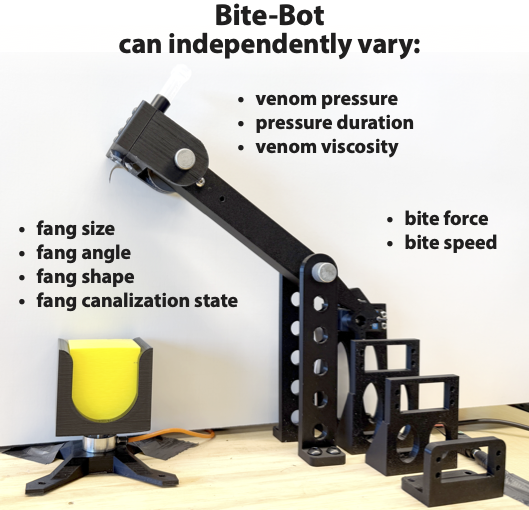
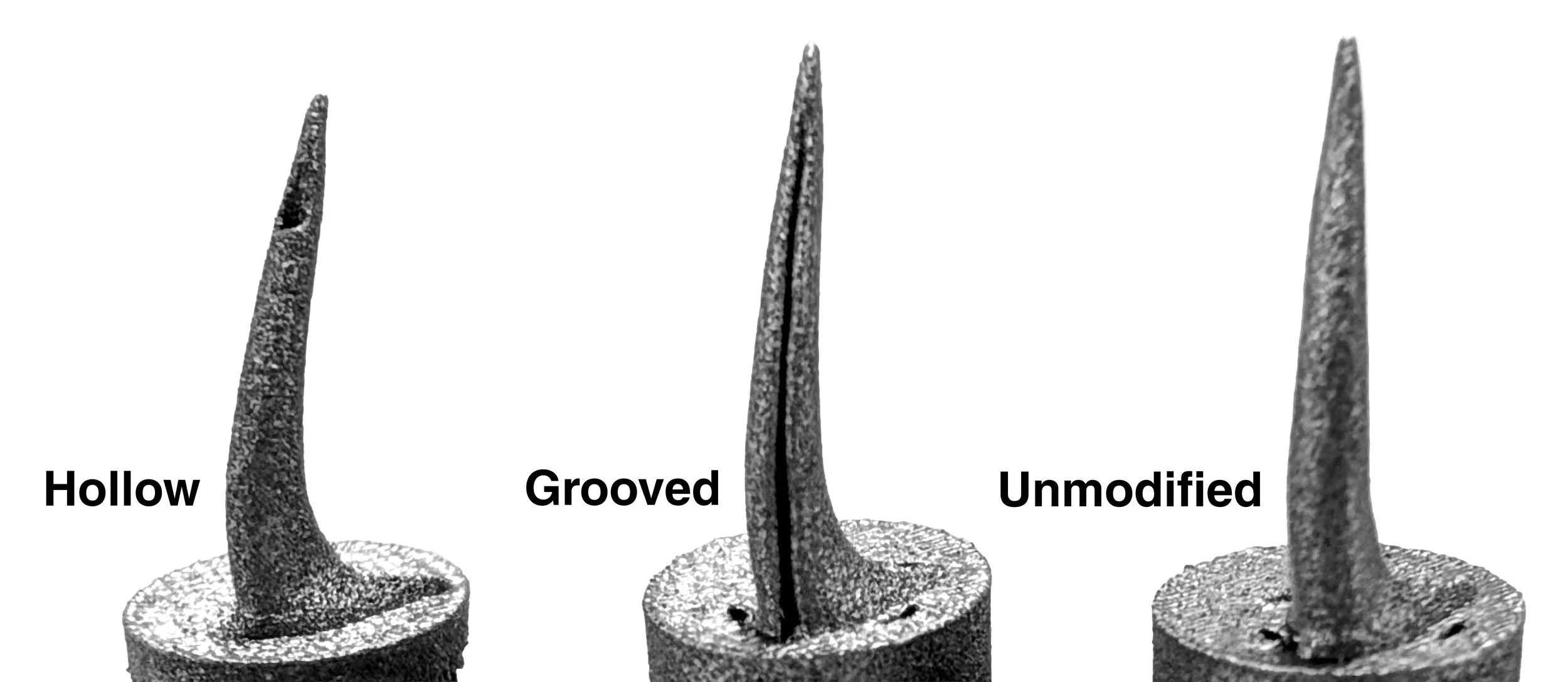
Envenomation is a complex process involving multi-physics interactions between the fang, the liquid venom, and the tissue of the target. Direct measurements of how fang shape modulates in-wound venom transport are scarce, as most studies isolate puncture performance or conduit hydrodynamics. It is widely assumed that tubular anterior fangs enable the most rapid, high-pressure delivery, but rigorous cross-type, standardized comparisons of delivery efficiency are limited. Here, we present Bite-Bot, a robotic platform designed to facilitate highly controlled experiments that reveal the constituent and combined effects of evolutionary variation in the envenomer and the target tissue. First, we obtained uCT scans of snake fangs that varied in overall shape and venom delivery mechanism and 3D printed them in titanium. Our robot controls the angle of attack, speed, and force of the bite. The robot also injects our bespoke venom phantom, which matches the rheological properties of specific snake species, at a given pressure. By leveraging robotics, we can now more holistically and empirically study the complex physical interactions and the coevolution between the envenomer and the target tissue.
@article{Cieply2026bitebot,
author = {Cieply, Jacob and Moore, Talia Y},
journal = {Integrative and Comparative Biology},
year = {\emph{in review}}
}