
Release Chamber Enables Suction Cup to Delaminate and Harvest Fluid
See our project page
Nominated, Best Student Paper
Winner, Best Paper in Benchmarking and Reproducibility
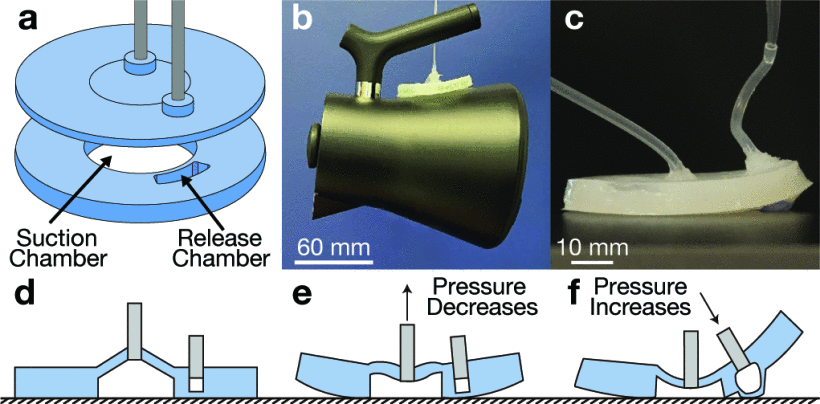
Suction is a useful strategy to grasp objects or anchor a body, especially when prolonged contact is desired. For passive suction cups, detachment requires manual delamination, which cannot occur autonomously. Active suction cups detach via equalizing pressure in the suction cavity with the surrounding environment, either by adding fluid (e.g., from a compressed air source) or reducing the cavity volume. While this detachment mechanism can be autonomous, it is inefficient, resulting in a net zero or loss of fluid. A more efficient detachment mechanism would enable multiple iterations of attachment and detachment without requiring additional fluid. To address this need, we designed a suction cup with a secondary release chamber embedded in the contact ring. The release chamber triggers delamination by deforming the shape of the contact ring. Through empirical testing, we found the optimal location and geometry of the release chamber. Our design allows for reliable detachment with a 5 mL decrease in release chamber volume, regardless of the adhesive suction force. Because the release chamber is a closed system, attachment and detachment results in net gain of fluid. Therefore, we propose a novel secondary benefit of adhesion via suction: harvesting fluid to power other pressure-driven soft robotic systems.
@inproceedings{bu2025release,
  title={Release Chamber Enables Suction Cup to Delaminate and Harvest Fluid},
  author={Bu, Xiangyun and Geng, Yihao and Yin, Siyuan and Luo, Liyan and Aubin, Cameron A and Moore, Talia Y},
  booktitle={2025 IEEE 8th International Conference on Soft Robotics (RoboSoft)},
  pages={1--6},
  year={2025},
  organization={IEEE}
}